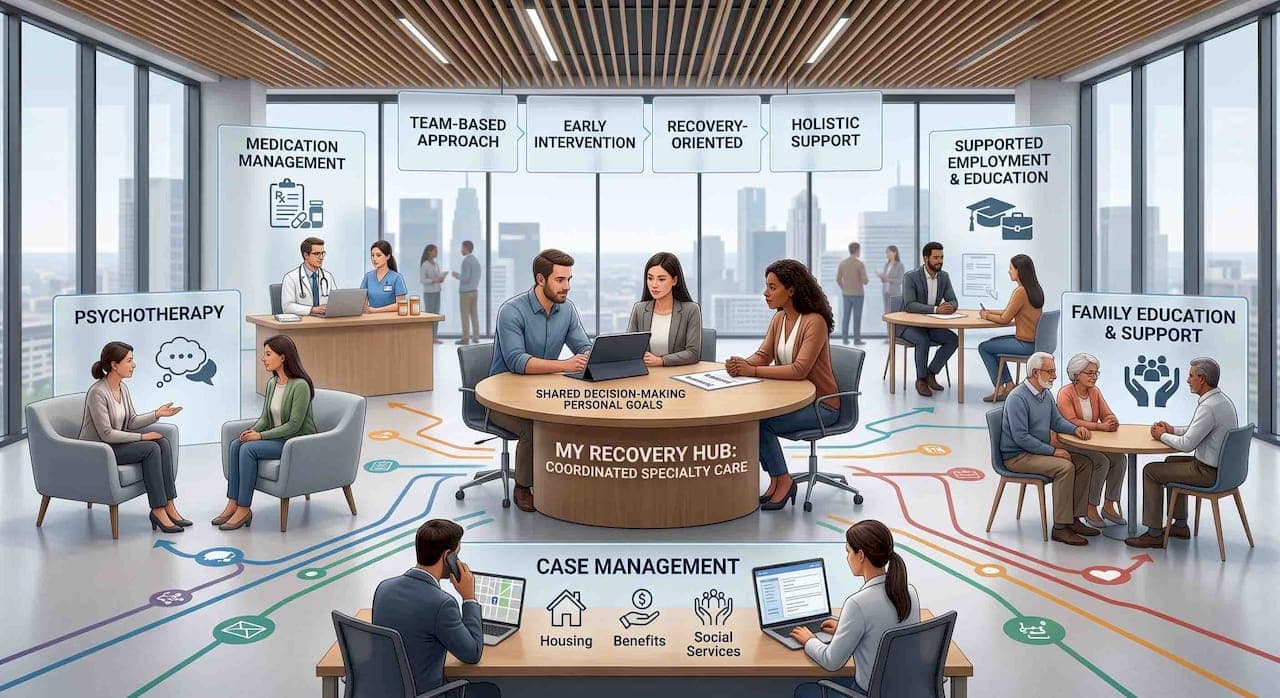
Coordinated specialty care for first episode psychosis (CSC) is defined as an evidence-based, team-based treatment model that integrates medication management, psychotherapy, family education, case management, and vocational support into a single, personalized plan. The standard industry term is “CSC for first episode psychosis,” often abbreviated as CSC-FEP. Recognized by the Center for Health Care Strategies and NAMI, this model targets individuals experiencing their first psychotic episode, typically between ages 15 and 35. Functional recovery should be the expectation, not the exception. When families and patients in California understand what CSC actually delivers, they are far better positioned to seek the right care quickly.
What are the key components of coordinated specialty care programs?
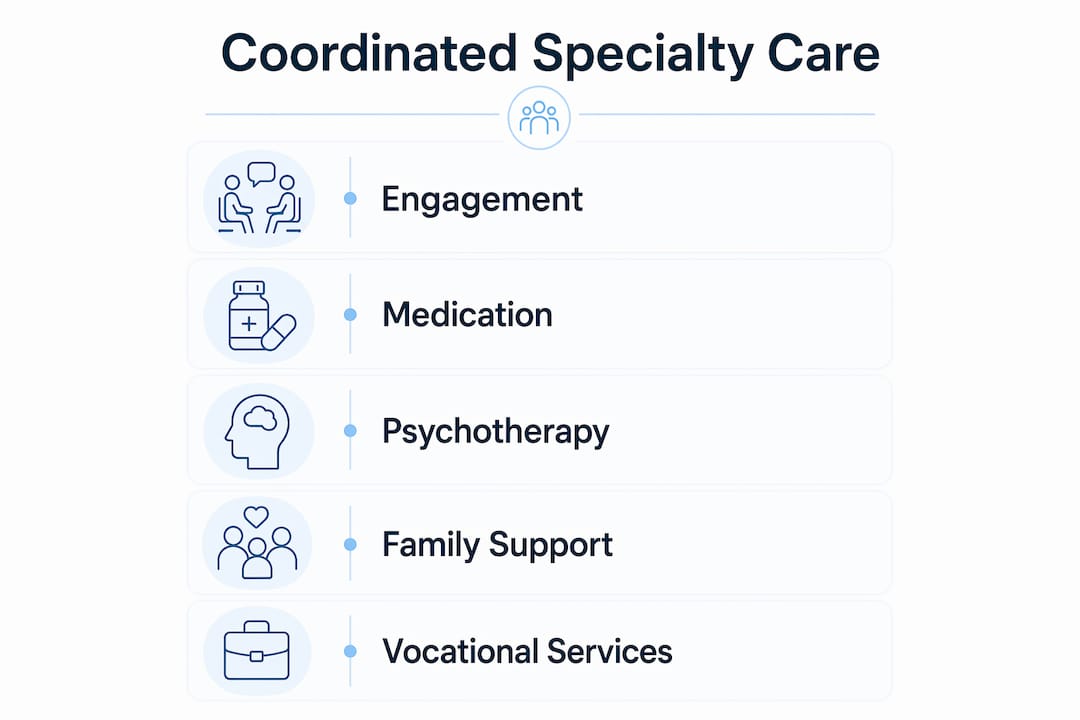
CSC’s core components include medication management, psychotherapy, family education, case management, and vocational support. Each component is evidence-based and delivered by a dedicated multidisciplinary team. No single intervention works alone. The power of CSC comes from integrating all five into one coordinated plan.
-
Medication management. The “start low, go slow” approach to antipsychotic prescribing reduces serious side effects and builds long-term adherence. This matters because patients experiencing a first episode are often more sensitive to medication than those with chronic illness.
-
Individual and group psychotherapy. Therapy is tailored to the patient’s recovery phase. Cognitive behavioral therapy for psychosis (CBTp) and acceptance-based approaches help patients understand their experiences and build coping skills.
-
Family education and support. Families receive structured psychoeducation to understand psychosis, reduce expressed emotion in the home, and support treatment engagement. Family involvement is not optional in high-fidelity CSC programs. It is a core clinical intervention.
-
Case management. A dedicated care coordinator links patients to community resources, monitors treatment adherence, and communicates across the team. This role prevents patients from falling through the cracks between appointments.
-
Vocational and educational support. Supported employment and education specialists help patients return to school or work. Maintaining functional roles is a direct predictor of long-term recovery.
Pro Tip: When evaluating a CSC program, ask specifically whether it employs a dedicated vocational specialist. Programs without this role often show weaker functional outcomes, even when clinical symptom scores improve.
How does coordinated specialty care improve outcomes for first episode psychosis?
Early intervention with CSC produces clear improvements in social, vocational, and symptom outcomes. Research consistently shows that patients enrolled in CSC programs experience fewer relapses, shorter hospitalizations, and better quality of life compared to those receiving standard outpatient care. These are not marginal gains. They represent a fundamentally different recovery trajectory.
“Extending early intervention services beyond two years supports long-term recovery and prevention of relapse. The protective effect of early CSC intervention may wane post-program without continued support, making extended services a clinical priority for patients with ongoing functional difficulties.”
The economic case for CSC is equally strong. One year of CSC costs approximately 50% less than a single inpatient psychiatric hospitalization. That figure reflects the real cost of untreated or undertreated psychosis, not just the cost of the program itself. Families and health systems both benefit when early intervention prevents repeated crisis episodes.
Despite this evidence, access remains a serious problem. Only 10–25% of eligible individuals in the United States currently access specialized CSC programs. That gap exists because programs are unevenly distributed, often concentrated in urban centers, and frequently under-resourced. In California, the situation is improving, but many families still face significant wait times or geographic barriers.
Assigning a single care team lead for coordination produces better functional outcomes than fragmented care. This finding from fidelity research confirms that structural features of CSC programs matter as much as the clinical interventions themselves. A program that offers all five components but lacks care continuity will underperform.
What does the typical care journey look like in coordinated specialty care?
The path through a CSC program follows a clear sequence, though the pace adjusts to each patient’s needs. Understanding this sequence helps families know what to expect and how to advocate effectively at each stage.
-
Referral. Patients enter CSC through self-referral, family referral, primary care providers, emergency departments, or community mental health services. Early referral after a first episode is critical. Delays between first symptoms and treatment entry worsen long-term outcomes.
-
Comprehensive assessment. The team conducts a full psychiatric, medical, and psychosocial evaluation. This assessment forms the foundation of the personalized care plan and identifies co-occurring conditions such as substance use or trauma.
-
Personalized plan development. The team, patient, and family collaborate to set recovery goals. Goals span symptom management, social functioning, education, employment, and family relationships.
-
Active treatment phase. The patient meets regularly with their psychiatrist, therapist, case manager, and vocational specialist. Service intensity is highest in this phase. The team meets together to review progress and adjust the plan.
-
Step-down planning. As the patient stabilizes, the team gradually reduces service intensity. Transitioning out of CSC requires proactive planning to avoid regression. The team connects patients to ongoing community supports before the program ends.
CSC programs typically last 2–5 years, providing enough time to stabilize symptoms, rebuild functioning, and prepare for independent community living. Shorter programs often discharge patients before they have consolidated their gains.
What challenges and considerations do patients and families face in CSC?

Access is the first barrier most families encounter. Programs are concentrated in cities, and rural or suburban families in California often travel significant distances for care. Telehealth has expanded access for some components, but in-person contact remains important for medication management and group therapy.
Medication side effects are a common reason patients disengage from treatment. The “start low, go slow” prescribing strategy directly addresses this by minimizing adverse effects during the most sensitive period of treatment. Patients who experience side effects should communicate them immediately to their prescriber rather than stopping medication without guidance.
Relapse is another area where families often need reframing. Relapse in early psychosis is common and is not a failure. It is a recognized phase of recovery that requires adaptive care adjustments, not a restart from zero. CSC programs are designed to respond to relapse with increased support rather than discharge or blame.
Family members sometimes underestimate how much their own behavior affects recovery. Expressed emotion, meaning criticism, hostility, or emotional overinvolvement in the home, is a well-documented predictor of relapse. Structured family psychoeducation, a core CSC component, directly addresses this dynamic. Families involved in education and support improve participation and outcomes across the board.
Pro Tip: If your family member’s CSC program does not offer structured family sessions, ask the care coordinator to connect you with a family psychoeducation group. NAMI’s Family-to-Family program is a free, peer-led option available in many California counties.
Key takeaways
Coordinated specialty care for first episode psychosis is the most evidence-supported treatment model available, combining five clinical components under one team to produce better outcomes than standard care alone.
| Point | Details |
|---|---|
| Five core components | CSC integrates medication, therapy, family education, case management, and vocational support into one plan. |
| Cost effectiveness | One year of CSC costs approximately 50% less than a single inpatient hospitalization. |
| Access gap | Only 10–25% of eligible individuals in the US currently receive specialized CSC programs. |
| Care continuity matters | Programs with a single dedicated team lead produce better functional outcomes than fragmented care. |
| Extended duration improves outcomes | Programs lasting 2–5 years, with planned step-down care, prevent regression after discharge. |
What I’ve learned from watching CSC programs work in practice
The research on CSC is compelling, but the clinical reality is even more striking. What separates programs that produce lasting recovery from those that produce temporary stabilization is almost never the medication protocol. It is the quality of the relationships between the patient, the family, and the care team.
I have seen families arrive at programs exhausted, frightened, and convinced that their loved one’s life has been permanently altered. The ones who engage fully with family psychoeducation, who show up to the sessions and ask hard questions, consistently report a different experience six months later. Not because the illness disappeared, but because they understood it well enough to stop fighting it and start working with it.
The emerging research on extended care duration confirms what experienced clinicians have observed for years. Two years is often not enough. Patients who are doing well at the two-year mark are not cured. They are stabilized. Maintaining that stability requires continued support, and programs that plan proactively for step-down care produce far better long-term results than those that abruptly discharge patients who appear functional.
My honest recommendation for families in California is to seek high-fidelity CSC programs that assign a dedicated care coordinator, include vocational support, and offer structured family sessions. Do not accept a program that checks three of the five boxes and calls itself CSC. The fidelity of the model matters as much as the label.
— eric
Pandhealth’s early psychosis care in Los Angeles
Pandhealth is a specialized mental health treatment center in Los Angeles serving teens and young adults ages 13–35 who are experiencing thought disorders, including first episode psychosis, schizophrenia, schizoaffective disorder, and bipolar disorder with psychotic features.
Pandhealth uses an augmented version of the California OnTrack CSC model, combining psychiatry, medication management, individual and group therapy, cognitive remediation, family psychoeducation, and supported education and employment. Every patient receives a personalized care plan developed with their family. The team includes psychiatrists, therapists, case managers, and vocational specialists working together under one roof. Families can begin with a free admissions consultation to learn whether Pandhealth’s program is the right fit. For teens specifically, Pandhealth offers a dedicated early intervention program for ages 13–17 designed around the unique developmental needs of adolescents.
FAQ
What is coordinated specialty care for first episode psychosis?
Coordinated specialty care (CSC) for first episode psychosis is an evidence-based, team-based treatment model that combines medication management, psychotherapy, family education, case management, and vocational support into a single personalized plan. It targets individuals experiencing their first psychotic episode and is designed to improve both clinical and functional recovery.
How long does a CSC program typically last?
CSC programs typically last 2–5 years, providing comprehensive care and a planned transition to ongoing community supports. Extending care beyond two years produces better long-term outcomes for patients with continued functional difficulties.
Is CSC available in California?
CSC programs are available in California, including through the state’s California OnTrack initiative, though access varies by region. Pandhealth in Los Angeles offers an augmented CSC model for teens and young adults ages 13–35.
Does insurance cover coordinated specialty care?
Coverage varies by plan and provider. Many CSC programs in California accept Medi-Cal, and some accept private insurance. Families should contact programs directly to confirm coverage before beginning the admissions process.
What should families do if their loved one refuses treatment?
Families should engage with the CSC team directly, even if the patient is initially reluctant. Family psychoeducation and outreach strategies within CSC programs are specifically designed to support engagement for patients who resist treatment early on.